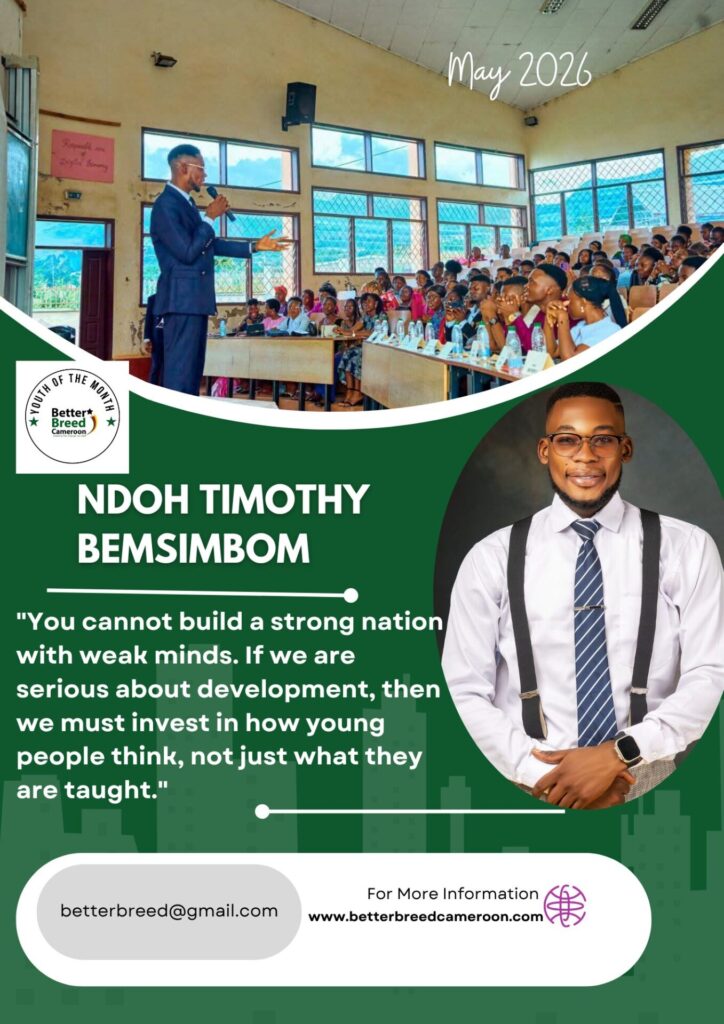
Timothy is an educator,writer, public speaker,and founder of BEMCEE Inspire.He commits to raising a better breed of Cameroonians who cultivate reading skills and intentionally involve in nation building.
Kindly introduce yourself and tell us about yourself,your field,your journey in that field.
My name is Ndoh Timothy Bemsimbom, also known as Sir Tim. I am a teacher of philosophy and logic, a writer, a public speaker, and the founder of BEMCEE Inspire. My journey started when I realized I had to start being intentional about my growth. Then, from a simple observation: many young people have degrees but lack clarity, depth, and expression. That gap pushed me into education beyond the classroom, focusing on reading, writing, and public speaking as tools to rebuild the mind.
What drives you to do this work,what impact have you achieved,and hope to achieve?
I am driven by the need to be significant, to live out my purpose and assignment, not just to be seen. My focus has never been noise but impact. Over the years, this has translated into hosting capacity-building programs, running 16 editions of a reading challenge, and reaching hundreds of young people across different spaces. Through this, I have seen people grow in how they think, speak, and express themselves. Going forward, my goal is to deepen this impact by building more structured systems that will not just inspire people but consistently train and transform them into conscious and intentional individuals.
Are you a student? If yes, how do you manage your time between school and passion? If No what does your daily routine entail?
No, I am not currently a student, but I am committed to lifelong learning. My daily routine is built around structure and intentionality. I dedicate time to teaching, creating content, mentoring, and running programs under BEMCEE Inspire, while also reading and learning consistently to improve myself. I plan my day based on priorities, not moods, and ensure that each day contributes to the larger vision I am building.
What are some of the major obstacles you’ve faced, and how have you overcome them?
Some of the major obstacles I’ve faced include imposter syndrome, especially at the beginning, where I constantly questioned if I was truly ready for the work. Finances were also a challenge when it came to running programs and expanding ideas. I overcame these by choosing growth over doubt, staying consistent, and working with what I had while building gradually.
Where do you see yourself in five years?
In five years, I want to have built the capacity to a level where I can consistently gather and train young people, not just occasionally but through structured systems that shape how they think, speak, and live. I am looking at building something more institutional, where young people are not just inspired but properly formed. A space where clarity, expression, and depth are developed intentionally. Beyond programs, I want to see a movement of young people who are conscious, articulate, and grounded, people who can stand anywhere and represent value.
To you, what does it mean to be a Better Breed?
To me, being a Better Breed means taking full responsibility for your life and growth. It is choosing to rise above excuses, being intentional about becoming better, and committing to continuous development. It is not about perfection, but about discipline, self-awareness, and the willingness to grow and do better consistently.
Many social issues in Cameroon are blamed on leadership but through your work you choose to be part of the solution.At what point in your journey did you decide to become an active solution-provider?
It started when I realized I needed to grow intentionally, so I invested a lot of time in discovering and building myself. As I grew to a certain level, it dawned on me that I was not just meant to grow for myself but to give back, serve, and solve some of the problems I had once faced. 8.What is one common societal belief or stereotype about young Cameroonians that you have intentionally rejected in your own life or work?One belief I have intentionally rejected is that young people are unserious or not ready. From my experience, many young people are not unserious, they are just not guided or exposed. When given the right structure and environment, they rise and do well.
Aside your current work and engagements,what specific sector in Cameroon do you most want to see transformed by 2035, and how is your current work laying a foundation for that transformation?
Education, especially the quality of thinking it produces. In an era of AI and a struggling educational system, many young people are becoming dependent on tools without developing their own minds or practical skills. There is a growing gap between having information and actually understanding and applying it. I want to see an education system that builds thinkers and equips people with real skills, not just graduates with certificates. My work in reading, writing, and public speaking is laying that foundation by training young people to think critically, communicate effectively, and develop skills they can actually use.
How do you ensure that your work doesn’t just benefit you personally, but actively helps others in your community to know better so they can do better?
It has never been about what I gain; it has always been about people and service. I design my work to prioritize the growth of others by creating platforms where they can learn, express themselves, and develop skills that help them become better.
In an environment where many seek the “American Dream,” you have chosen to fantasize about something uniquely Cameroonian and make it real. What has been your biggest challenge in staying rooted in Cameroon, and how did you overcome it?
The biggest challenge has been the strong narrative that success only happens abroad. It can make you question your decision to stay. But I have chosen to believe that we can make it in Africa. I overcame it by staying rooted in my purpose and focusing on building impact here, proving that meaningful work can be done and sustained within our own environment.
How are you breeding the next generation in your field?Are there ways you are already mentoring or opening doors for other youth?
Yes, of course. This is a core part of what I do. Through reading challenges, trainings, and mentorship, I am constantly creating platforms for young people to grow, express themselves, and develop their skills. I don’t just teach; I give them opportunities to practice, take responsibility, and become.
What do you think is the long-term sustainability of the impact you are making?
The sustainability of my impact is rooted in people and structure. I am not just running programs; I am building people who can continue the work and systems that can function beyond me. If it depends only on me, then it is not sustainable, so my focus is to make it bigger than myself.
what is the one key lesson or truth you want policy-makers and other young Cameroonians to take away from your journey so far?
You cannot build a strong nation with weak minds. If we are serious about development, then we must invest in how young people think, not just what they are taught.
Drawing from your experiences,what are some recommendations you would give to improve the lives of youth in your sector?
Prioritize critical thinking, communication, and practical skills over certificates, and create more platforms where young people can learn, express themselves, and grow.
Better Breed Cameroon’s motto is “Breeding the Change we Need.” If you were the only “breeder” of this change for one day in Cameroon, what is the very first thing you would change about how youth are treated in Cameroon?
I would change how young people are listened to. Many are corrected, dismissed, or ignored before they are even understood. If we start listening to them genuinely, we will unlock a lot of potential that is currently being overlooked.