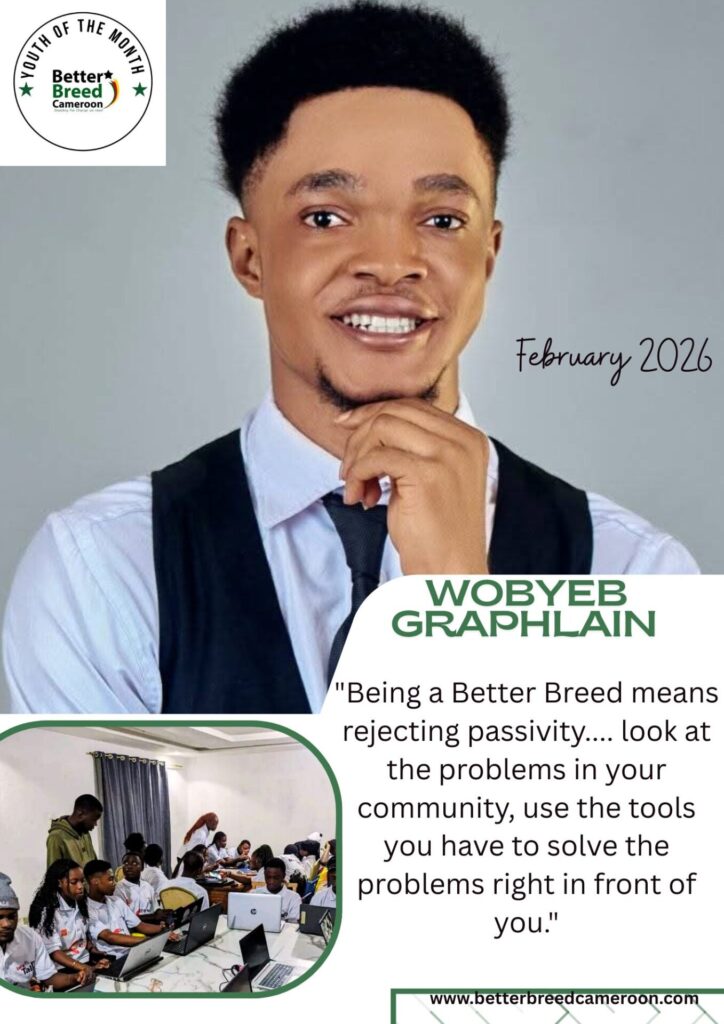
Graphlain is a Bamenda-based tech leader and the visionary behind Let’s Talk Tech and Truth Nexus. What began as a passion for solving community challenges through technology has grown into a movement empowering youth with digital skills and safer online spaces. Through his work, he champions innovation, resilience, and youth-driven change.
Kindly introduce yourself and tell us about your field, and your journey in that field.
I am Wobyeb Graphlain, a youth leader,researcher, and tech enthusiast from Bamenda,Cameroon.My journey began with a strong desire to solve problems in my community using technology. Over the years, I have grown into a full tech expert. I currently serve as the founder of initiatives like Let’s Talk Tech which is a youth empowerment initiative designed to build thenext generation of tech leaders by equipping them with relevant, employable digital skills and Truth Nexus which is a platform that leverages AI and machine learning models to combat misinformation, fake news, and cyber threats
What drives you to do this work, what impact have you achieved, and hope to achieve?
I am driven by the reality of my environment. Living in a region affected by the Anglophone crisis, I have seen people suffer, and I want to be a voice for change. I believe technology can build peace and create jobs.Regarding impact, I have trained over 100 young people directly and 300 indirectly in digital skills. Recently, I empowered 45 youth with skills like bookmaking and web design, helping them earn money while in school. My hope is to build a tech incubator in Bamenda that stops youth unemployment and reduces crime.
Are you a student? If yes, how do you manage your time between school and passion?If No what does your daily routine entail?
No, for now I am not a student , but I prioritize planning. I use my holidays and weekends intensely for my community projects. For example, during the last Christmas break, while others were resting, I organized a two-week training for 34 youths. During the semester, to make sure I deliver it, keep my projects moving by delegating tasks to my team.
What are some of the major obstacles you’ve faced, and how have you overcome them?
The biggest obstacle has been the instability in the North West Region. Strikes, lockdowns, slowinternet , light shortage, high cost of gadgets really makes it very hard to work as a digitalcreator/ Techie. I overcome this by being adaptable, and flexible. I rely on the strong network Ihave built with organizations , which provide support when things get tough.Which i have alsotaken into consideration making many of the apps we are developing to work with little or no internet.
Where do you see yourself in five years?
I see myself leading one of the biggest tech hubs in Cameroon and Africa at large. I want Truth Nexus and Kigango SafeWave, some of our apps we have developed, to be standard tools used across Africa to fight cyber threats and fake news. I plan to have a system where I am not just training students, but employing them to build solutions for the world.I envision myself influencing tech policy at a continental level and to build the next Silicon valley of Cameroon. I also see myself scaling my tech company called Wobyx which we will belaunching this year in 2026 from a team of six to a major technology hub in the North West Region that employs thousands of young people.
To you, what does it mean to be a Better Breed?
To me, being a “Better Breed” means rejecting passivity. It means you do not wait for the government or international bodies to save you. Instead, you look at the problems in your community, use the tools you have to solve the problems right in front of you.
Many social issues in Cameroon are blamed on leadership but through your work you choose to be part of the solution. At what point in your journey did you decide to become an active solution-provider?
The turning point was seeing the direct link between idleness and violence during the crisis. I saw young people joining armed groups or getting into cybercrime (Scamming) ,and a high rate of pregnancy because they had no other options. I realized that complaining about leadership would not save them. I decided then to use my skills to give them a different path: a path of digital employment and self-reliance.Complaining changes nothing. When I saw how misinformation and fake news is so common, I did not just talk about it; I founded Truth Nexus to use AI to verify facts. When I saw youth idleness, I did not just blame the economy; I started Let’s Talk Tech to give them skills. I decided to become a solution-provider when I realized I had the skills to make a difference.
What is one common societal belief or stereotype about young Cameroonians that youhave intentionally rejected in your own life or work?
I reject the belief that you must travel abroad (bushfall) to succeed or make a global impact.Many people think nothing good can come from Bamenda right now or Cameroon in general. I challenge this by building world-class tools like AI-powered cyber defense systems right here in the North West. We can solve global problems from our local communities.and trained over 100 with tech skills while still in Cameroon, the impact is real.
Aside your current work and engagements, what specific sector in Cameroon do you most want to see transformed by 2035, and how is your current work laying a foundation for that transformation?
I want to see the Education sector transformed. Our current system is behind and outdated. I want a curriculum that teaches digital literacy, AI, and critical thinking from primary school. My work with Let’s Talk Tech lays the foundation by filling this gap. We are showing the government and schools that when you teach a student practical tech skills, they become productive immediately as compared to theory.By training youth in practical skills like bookmaking and cyber security, I am demonstrating the kind of vocational education our country needs.
How do you ensure that your work doesn’t just benefit you personally, but actively helps others in your community to know better so they can do better?
I have a rule: I never learn alone. I ensure this through step-down activities. After every major program I attend like REPAIR series or Emerging Leader through The Denis & Lenora Foretia Foundation I organize workshops to pass that knowledge on. Also after training youth in the Let’sTalk Tech programs,I help connect them to different organizations so they can apply their skills and earn a living.
In an environment where many seek the “American Dream,” you have chosen tofantasize about something uniquely Cameroonian and make it real. What has been yourbiggest challenge in staying rooted in Cameroon, and how did you overcome it?
The biggest challenge is the lack of resources and infrastructure compared to the West. It istempting to leave for better internet and electricity. However, I overcome this by focusing on thewhy. I believe Africa deserves home-grown protection and solutions. If I leave, who will build thedigital defenses our people need? That sense of duty keeps me grounded.
How are you breeding the next generation in your field? Are there ways you arealready mentoring or opening doors for other youth?
I am breeding the next generation through mentorship and practical exposure. I don’t teach them theory. Recently, I trained 45 youths to create books and brands. After the training, I connected them with organizations for internships so they could work on real projects. I want them to be better than me, so I share every opportunity and connection I have with them.
What do you think is the long-term sustainability of the impact you are making?
The sustainability lies in economic independence. When I teach a young person to be a graphic designer or a web developer, they gain a skill that feeds them for life. They become self-employed and less likely to engage in conflict. We are moving youth from dependency to productivity, which creates lasting peace and economic growth.
What is the one key lesson or truth you want policy-makers and other young Cameroonians to take away from your journey so far?
The key lesson is that youth are ready. We received over 300 applications for a training that could only take 45 people. This proves that young people are hungry for knowledge and work. Policy-makers need to stop planning for us and start planning with us. Give us the tools and the and the space, and we will build the country.and one thing is just start at the beginning you will never always have all the ideas but during the process you will .Drawing from your experiences, what are some recommendations you would give to improve the lives of youth in your sector?First, we need better internet infrastructure; it is the road we travel on as tech workers. Second,the education system must update its curriculum to include modern digital skills. Finally, we need more support for local innovation. Grants and funding should go to youth who are actually building things on the ground, not just those writing good reports.16. Better Breed Cameroon’s motto is “Breeding the Change we Need.” If you were the only “breeder” of this change for one day in Cameroon, what is the very first thing you would change about how youth are treated in Cameroon?I would change how youth are viewed in decision-making processes. I would move youth from the audience section to the speakers table. I would ensure that no policy about the future is written without the direct, active contribution of the young people who have to live in that future. We deserve to be partners in governance, not just observers.