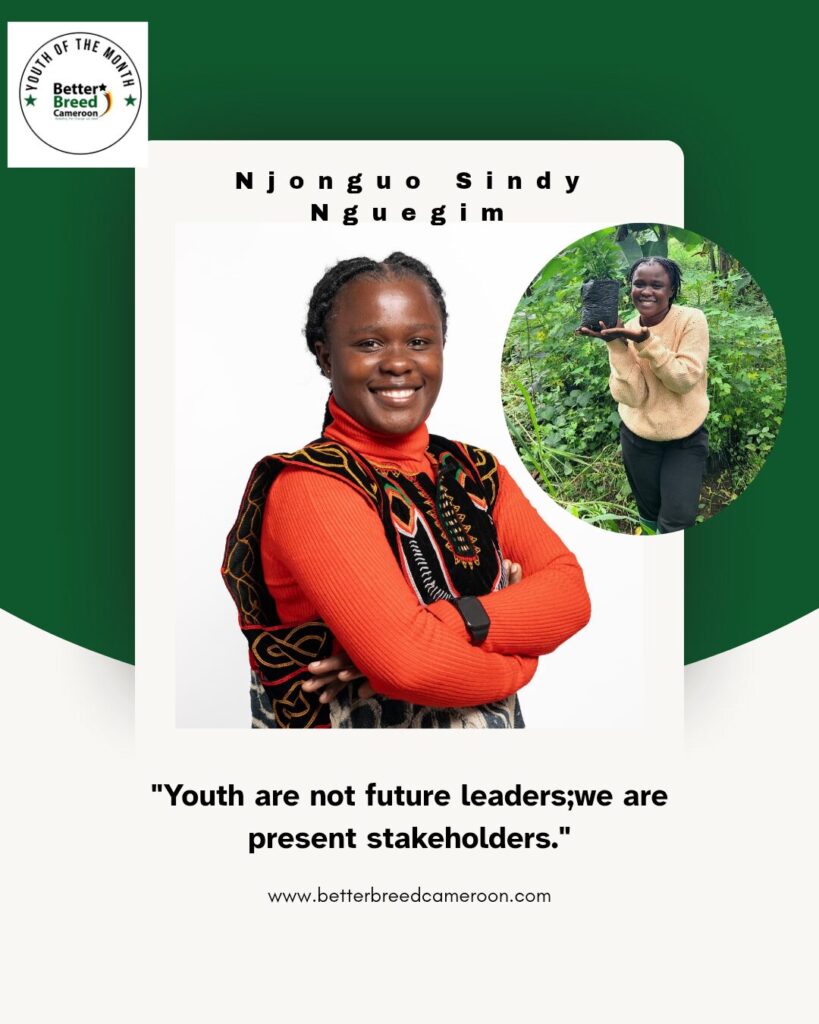
Njonguo Sindy Nguegim is changing how young people see agriculture. What started as a burden became a purpose rooted in action and hope. Through innovation and climate advocacy, she is showing that farming can be smart, impactful, and led by youth.
Kindly tell us about yourself, your field, and your journey in that field.
My name is Njonguo Sindy Nguegim, a multi-award-winning youth leader in agriculture and climate advocacy, and an agri-tech innovator, but my roots were not planted in comfort. Initially, I viewed the agriculture as a burden—a heavy weight I was forced into by the firm hand of my father. I did not choose the field; the field was chosen for me. However, I later had the realization that what I initially perceive as a shadow was the very light we need to grow. I transformed that forced labor into a life’s mission. By bridging the gap between biology with the structural power of policy, I have dedicated myself to advocating for sustainable food systems.
What drives you to do this work, what impact have you achieved, and hope to achieve?
I am driven by the desire to shift perceptions of agriculture and empower youths. To change a nation, one must first change its imagination. I have inspired over 50+ million people via agriculture influencing, reached approx. 20,000 lives across Africa through my NGO the Africa Humanitarian Development Peace Organization, and personally impacted approx. 5,000 through direct engagement. I also built an early warning system to help beekeepers. My goal is not merely to feed mouths, but to build a sustainable global food system through the twin pillars of education and relentless advocacy
Are you a student? If yes, how do you manage your time between school and passion? If No what does your daily routine entail?
Yes, I am a student, currently pursuing my MS in Agricultural Economics and Agribusiness at the University of Buea. I manage my time by understanding that my studies are the foundation for my passion. I do not separate my school from my soul; I prioritize my academic rigor while seamlessly integrating my climate action and agricultural advocacy into my daily routine. To learn the economy of the land while working the land is to achieve a harmony that most never find.
What are some of the major obstacles you’ve faced, and how have you overcome them?
I have faced the biting winds of digital violence, the narrow walls of gender criticism, the heavy dampness of discouragement, a chronic lack of funding, and systemic barriers designed to keep the status quo. Wisdom has taught me that a tree that stands alone on a hill grows the deepest roots to survive the storm. I overcame these obstacles by building an internal fortress of passion and resilience. I sought strength in my community, and most importantly, I learned the art of silence—avoiding the ‘noise’ of the world to stay locked onto my mission.
Where do you see yourself in five years?
In five years, I do not just see myself working; I see myself leading. I envision myself as a prominent, leading voice in global food policy. I will be at the tables where the future of our planet is decided, continuing to champion sustainability and gender equity in agriculture. My influence will not be solitary; I see my organization and my startup expanding their reach, creating ripples of change that will be felt far beyond the borders of my current reach.
To you, what does it mean to be a Better Breed?
To me, being a “Better Breed” is an internal state that manifests in external action. It means refusing to be a passive observer of history but actively driving positive change through empathy, leadership, and innovation.
Many social issues in Cameroon are blamed on leadership but through your work you choose to be part of the solution. At what point in your journey did you decide to become an active solution-provider?
I chose to become a solution-provider early in my journey when I realized the significant impact agriculture has on communities, the future, and the need for youth engagement to build a sustainable food system. While in the field, I realized the undisputable connection between agriculture and climate action, paving the way for my climate journey. It then was essential for me to advocate for positive, sustainable practices rather than criticize existing systems.
What is one common societal belief or stereotype about young Cameroonians that you have intentionally rejected in your own life or work?
I have intentionally and aggressively rejected the societal stereotype that agriculture is the final refuge for the uneducated or the unsuccessful. I have made it my life’s work to reframe the farm as a laboratory of innovation and a theater of growth. I am rebranding the soil. I want the world to see that agriculture is ‘SEXY,’ sophisticated, and filled with opportunities for those who are brave enough to be innovative.
Aside your current work and engagements, what specific sector in Cameroon do you most want to see transformed by 2035, and how is your current work laying a foundation for that transformation?
I want to see a nation that breathes in harmony with its resources. My current work is the foundation for this transformation; by creating awareness about sustainable agricultural practices today, I am planting the seeds for an environmental renaissance that will flourish in years to come.
How do you ensure that your work doesn’t just benefit you personally, but actively helps others in your community to know better so they can do better?
My work aims inspire to inspire Cameroon youths to join agriculture, uplift the communities especially grassroots, while supporting our rural women who are the backbone of our food systems. I belief that by providing education, mentorship, and amplifying youth voices, I walk towards ensuring that everyone has the tools needed to make a difference.
In an environment where many seek the “American Dream,” you have chosen to fantasize about something uniquely Cameroonian and make it real. What has been your biggest challenge in staying rooted in Cameroon, and how did you overcome it?
My biggest challenge in staying rooted in Cameroon was overcoming the “gravity of elsewhere”—the pervasive belief that success is a seed that can only sprout in foreign soil. I overcame this by shifting my fantasy from a life abroad to a reality at home. I realized that the friction of our local challenges is exactly what produces the heat for true innovation. I chose to be the architect of my own environment rather than a tenant in someone else’s dream.
How are you breeding the next generation in your field? Are there ways you are already mentoring or opening doors for other youth?
I am breeding the next generation by acting as a living bridge between tradition and the future. I mentor by opening doors that were once locked to me, showing the youth that agriculture is not a place of drudgery, but a piece for technology and prestige. I do not just give them tools; I give them the permission to lead, ensuring that they see themselves as the masters of their own destiny
What do you think is the long-term sustainability of the impact you are making?
I believe the long-term sustainability of my impact lies in its circularity. By focusing on the “backbone”—the women and the youth—I am planting seeds in the minds of those who cannot be moved. I belief that when knowledge becomes a shared community asset rather than a hidden secret, it becomes a culture. A project can end, but a culture of self-sufficiency is immortal.
what is the one key lesson or truth you want policy-makers and other young Cameroonians to take away from your journey so far?
The one key truth I want policy-makers to take is that inclusion is not a favor you do for the marginalized; it is a requirement for national survival. If you center women and youth in agricultural discussions, you are finally listening to the pulse of the nation. Ignoring the backbone of the food system is an invitation to economic collapse.
Drawing from your experiences, what are some recommendations you would give to improve the lives of youth in your sector?
It’s time we make ‘agriculture SEXY’. Don’t be shy to share that beautiful farming story and who said you can’t be an agric influencer? Also, when youths collaborate instead of compete, the entire sector undergoes a transformation.
Better Breed Cameroon’s motto is “Breeding the Change we Need.” If you were the only “breeder” of this change for one day in Cameroon, what is the very first thing you would change about how youth are treated in Cameroon?
If I were the sole “breeder” of change for a day, the very first thing I would change is the perception of youth as “future” leaders. I would demand they be recognized as “present” stakeholders. I would move them from the audience to the altar of decision-making, ensuring that no policy is drafted without the signature of those who will have to live with its consequences