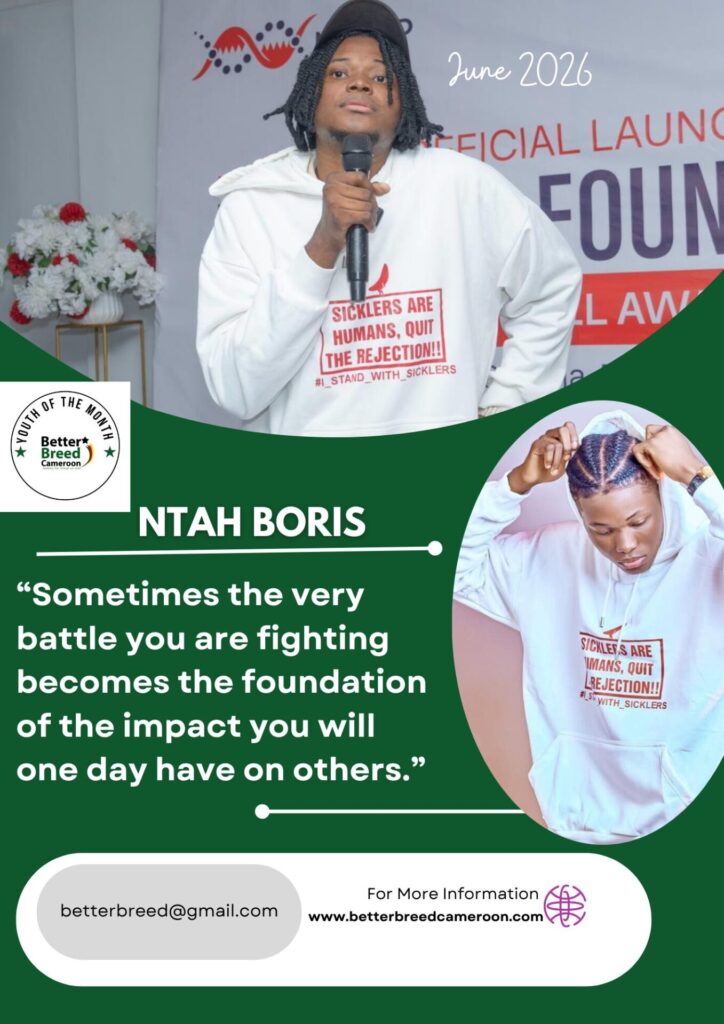
Sickle cell advocate and community leader Ntah Boris has turned his personal journey with sickle cell disease into a powerful mission of awareness, resilience, and hope. Through storytelling and advocacy, he is educating communities, promoting genotype testing, and inspiring young people in Cameroon and beyond to create positive change.
Kindly introduce yourself and tell us about the person behind the public figure many people know today
My name is Ntah Boris,a sickle cell advocate, storyteller, and community leader, but behind the public image is simply a young Cameroonian who has spent most of his life learning how to survive, adapt, and find purpose in pain. I am that sick kid whose journey has been shaped by hospital visits, painful crises, uncertainty, and moments that could have easily broken my spirit.Beyond advocacy, I am someone who deeply believes that every life has value and that our struggles can become tools for helping others. That is why my experiences taught me compassion, resilience, and responsibility, not hate.
If someone met you for the first time and knew nothing a bout your journey, what part of your story would you want them to understand first?
I would want them to understand that my story is not primarily about suffering; It is about purpose!Sickle cell disease has been one of the biggest realities of my life, but it has never been the entirety of who I am. I want people to know that behind every achievement, every awareness campaign, and every public engagement is someone who has had to fight battles that many people never see. Understanding that reality helps people appreciate not just the work I do, but also the reason why I do it, and how I do it by letting exhaustion take the wheel.
At what point did you realize that your personal experiences could become a tool for empowering others rather than a limitation?
There was a time when I viewed my experiences as something to hide and be ashamed of.When I began sharing my story publicly, I noticed something remarkable: people were finding hope in my honesty, parents felt understood, warriors felt less alone, young people started asking questions about genotype testing and prevention. Seeing such results was when I realized that my scars carried lessons. The very experiences I once considered limitations became the foundation of my advocacy. I understood that if my story could help even one person avoid pain or find hope, then my struggles had a greater purpose, and it is nothing to be ashame about.
Your journey has undoubtedly come with challenges. How have difficult moments shaped your character, values, and approach to life?
Difficult moments have taught me humility and gratitude. Living with sickle cell has shown me how fragile life can be, which is why I try not to take opportunities, relationships, or good health for granted. This challenge has also taught me empathy because pain gives you a deeper understanding of other people’s struggles.Most importantly, difficult moments have taught me resilience. I have learned that strength is not the absence of pain but the decision to keep moving despite it.
What is one experience that completely changed the way you view purpose, success, or service to others?
One experience that transformed my perspective was realizing that awareness alone can save lives. Every time I hear someone say they did a genotype test because of a campaign I was involved in, or that they made informed marriage decisions because of information we shared, I am reminded that success is not measured only by personal achievements. True success is measured by the positive impact we leave in the lives of others, and realizing that fact changed the way I define purpose and service.
Looking beyond titles and achievements you might have had over the years, what impact are you most proud of having on the lives of other young people?
I am most proud of helping young people understand the importance of genotype testing and informed decision making. If a young person avoids the pain and challenges associated with preventable sickle cell births because of a conversation, an awareness campaign, or a story I shared, that impact is greater than any title I could ever receive. I am so proud whenever young sickle cell warriors tell me they have found courage to pursue their dreams despite their circumstances.
What is one misconception people often have about resilience, and how has your own journey challenged that belief?
Many people believe resilience means never feeling weak or never struggling emotionally. Well, my journey taught me the opposite!Resilience is not pretending everything is fine, or lying to oneself, It is acknowledging the pain, fear, and uncertainty while choosing not to surrender to it.Most of the strongest people I know have cried, doubted, and struggled, and that is why I said RESILIENCE is found in continuing despite those realities.
Many young people wait for ideal conditions before taking action. What has your experience taught you about creating impact where you are, with what you have?
My experience has taught me that perfect conditions rarely exist.Some of my advocacy work was done while I was battling my own health challenges. I have shown up for awareness campaigns on wheelchairs, underarm crutches, and hand crutches because I believed the message was bigger than my discomfort. Impact begins when we stop focusing on what we lack and start using what we already have. I lack good health but i didn’t focus on that, I focused on the bad one I got.That might sound goofy but actions taken consistently often create extraordinary results. I am a proof.
To you, what separates a young person who merely complains about problems from one who actively becomes part of the solution?
The difference is responsibility. Do you know it is easy to identify problems? I mean, everyone can do that. But becoming part of the solution requires commitment, sacrifice, and action. Solution-oriented young people ask, “What can I do?” instead of only asking, “Why is this happening?” I stopped asking why my health is how it is and started thinking about why it is that way, and that was how I understood the change.Youths must understand that change begins with personal responsibility and consistent effort.
Name two societal issues you believe affect young Cameroonians most, and what role do you think youth should play in addressing it?
The first issue is lack of adequate health awareness, especially regarding preventable conditions like sickle cell disease. The second is hopelessness among young people caused by economic and social challenges.Young people must become educators, innovators, and community leaders. We should not wait for change to happen. We should actively participate in creating it by sharing knowledge, building initiatives, supporting one another, and using our voices responsibly.
How do you ensure that the work you do is sustainable?
Sustainability comes from collaboration, education, and empowering others. My goal is not simply to raise awareness myself but to inspire more advocates, volunteers, and organizations to continue the work. Lasting change happens when knowledge is shared and communities take ownership of the mission. I also remind myself that sustainability requires balance because serving others effectively means taking care of yourself too.
Who are the people or experiences that have most influenced the leader and advocate you are today?
My greatest teachers have been my experiences living with sickle cell disease. The hospital rooms, painful crises, uncertainties, and victories have all shaped my perspective. I have also been influenced by fellow warriors, caregivers, healthcare professionals, mentors, and the countless individuals whose stories remind me why advocacy matters. Every person who has shared their struggle with me has strengthened my commitment to this cause.
If you could influence one policy, one system, and one public attitude in Cameroon today, what would they be and why?
I would advocate for a policy that makes genotype testing more accessible and widely encouraged.I would improve the healthcare system’s support for sickle cell patients by strengthening awareness, early diagnosis, and access to care.I would change the public attitude that sees sickle cell as merely a personal issue rather than a national public health concern. Changing that mindset would lead to greater support, understanding, and action.
Looking ahead to the next decade, what kind of Cameroon would you like future generations to inherit, and how does your current work contribute to that vision?
I would like future generations to inherit a Cameroon where health awareness is widespread, where genotype testing is normalized, where preventable suffering is reduced, and where people living with sickle cell are treated with dignity and understanding. My work contributes to that vision by educating communities, challenging misconceptions, encouraging informed choices, and building conversations that can save lives for generations to come.
Better Breed Cameroon’s motto is “Breeding the Change We Need.” In your own understanding, how does your work create lasting value for others and contribute to positive change within your community and sphere of influence?
My work creates lasting value by transforming information into action. Awareness alone is not enough; people must be empowered to make informed decisions. Through advocacy, storytelling, education, and community engagement, I help people understand realities that directly affect their lives. If a family is better informed, if a young person chooses to know their genotype, or if a warrior feels seen and supported because of my work, then positive change has already begun. That is how lasting impact is created.
What is one message you would like every young Cameroonian, especially those facing some challenges, to remember from your journey?
Your circumstances are real, but they do not have the final say over your future. I have learned that labels, limitations, and hardships do not define a person’s worth or potential. There were moments when life seemed determined to reduce me to my diagnosis, yet purpose kept calling me forward. Whatever challenge you are facing today, do not allow it to convince you that your story is over. Sometimes the very battle you are fighting becomes the foundation of the impact you will one day have on others. Keep going. The world still needs what only you can contribute.I am the version of myself that no one can ever be.