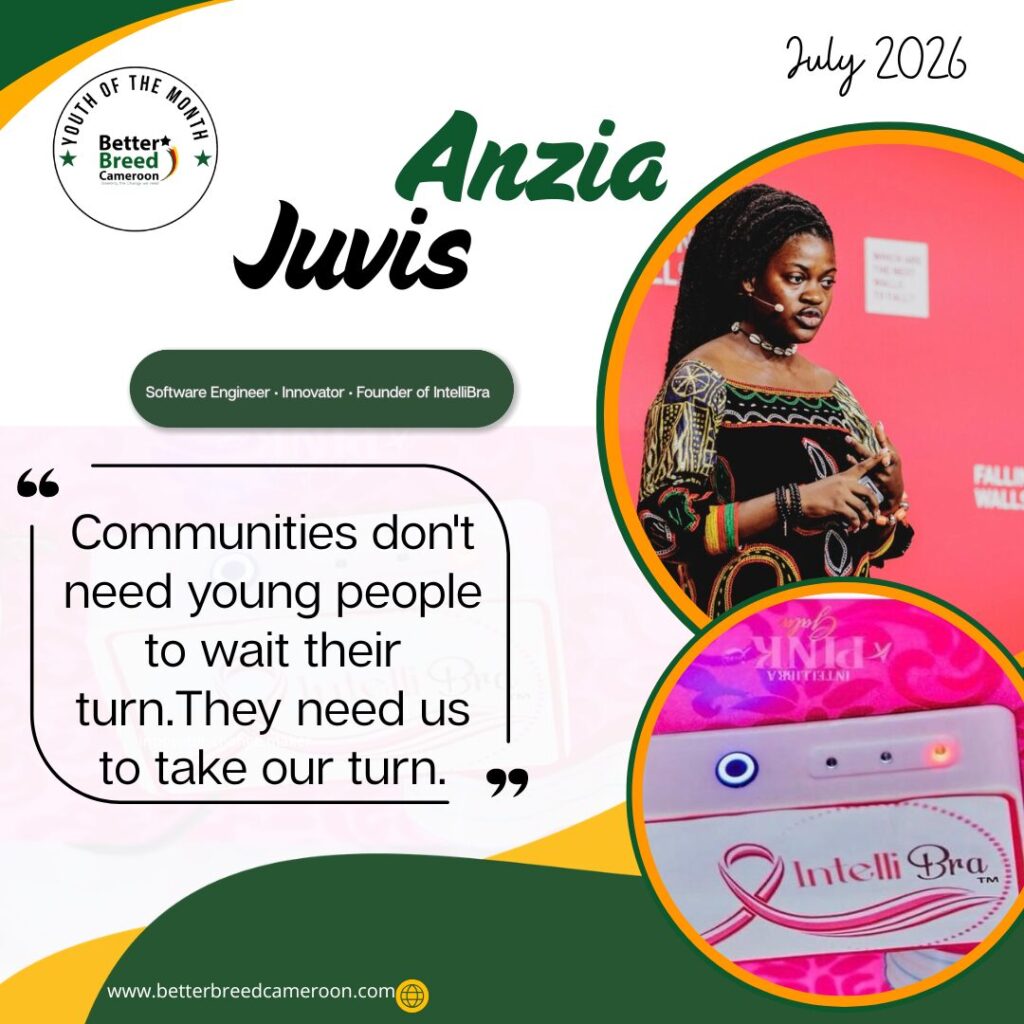
From personal loss to life-saving innovation, Anzia Juvis is redefining what it means to use technology for social impact. In this edition of Better Breed Cameroon’s Youth of the Month, the founder of IntelliBra shares her inspiring journey, the story behind her groundbreaking innovation, and her message to young people determined to create meaningful change.
Who is Anzia Juvis beyond being the founder of IntelliBra?
Beyond IntelliBra, I’m a software engineer and a builder at heart. I fell in love with making things: code, circuits, little robots that half-worked until they fully did. I studied Software Engineering, and I work as a full-stack developer at AMLA Cameroon. I’m someone’s daughter, someone’s friend, an ordinary girl from Yaoundé who asks “why not?” a little too often.
What shaped your passion for innovation?
Two things shaped me. The first was discovering, in secondary school at G.B.H.S. Etoug-Ebe, that I was good at the things girls were quietly told weren’t for them, and that told me the ceiling was imaginary. The second was loss, which I’ll speak about honestly: in 2021 I lost my best friend, and grief turned my skills into a mission. Between those two moments were years of building :Arduino projects, mobile apps, embedded systems, each one teaching me that innovation isn’t a lightning strike. It’s a habit.
What inspired IntelliBra?
In 2021, my best friend died of breast cancer. She was diagnosed too late not because the disease was untreatable, but because nobody was looking. In Cameroon, 70% of breast cancers are found at a late stage; a mammogram costs 35 to 40 thousand francs and fewer than one woman in ten can access screening at all. I sat with that injustice and realized I had the exact skills, sensors, AI, software to attack it. IntelliBra is my answer to a question grief asked me: what if someone had been looking, in time?
How would you explain IntelliBra to someone discovering it?
Imagine a bra that can check you for breast cancer. That’s IntelliBra: a wearable device with sensors, read by artificial intelligence in minutes, at a small screening point in your own neighborhood, no hospital, no long journey, for 3,000 francs, the price of a meal. If the AI notices something, a real doctor reviews it and you’re referred within 24 hours. The impact we’re chasing: over 100,000 women screened in our first three years, and around 800 tumours caught early enough to be treated.
What motivated you to apply your skills to a women’s health challenge?
Because I am one of the women this disease hunts. Breast cancer is not an abstract problem to me, it took my best friend, and it threatens every woman I love. I also noticed something uncomfortable: most health technology is built far away, by people who have never sat in a Cameroonian waiting room, trained on data from women who don’t look like us. I had engineering skills, and I had proximity to the problem. When skill and proximity meet, I believe you inherit a responsibility.
What’s your most exciting milestone so far?
Winning the Grand Prix of POESAM 2026 was extraordinary but honestly, two quieter moments compete with it. The day the Ministry of Public Health authorized our clinical trials, because that was the state saying “this is real innovation, proceed.” And the Pink Gala in Yaoundé, when more than 250 people watched the prototype live, I looked at that room and understood that IntelliBra no longer belonged only to me. It belonged to a community.
What does being recognised as a young Cameroonian innovator mean to you?
It means visibility and visibility is fuel for others. When I was a girl doing STEM, I searched for faces like mine in technology and found very few. Every recognition like this one from Better Breed Cameroon puts one more image in front of one more girl who is quietly wondering whether she’s allowed to dream in this direction. So I receive it with gratitude, but also with responsibility: this spotlight isn’t a trophy to keep, it’s a torch to pass.
What obstacles have you faced, and what lessons did they teach you?
Many. Building medical hardware in Cameroon means importing components, improvising labs, and explaining to skeptics why a young woman is building a “smart bra.” Funding was a constant battle, we survived on prizes and grants for years. Regulation was a mountain: medical devices demand a rigour that no hackathon prepares you for. And there was doubt, including my own. The lessons: start before you feel ready; say your limitations out loud before others weaponize them; surround yourself with people smarter than you in the areas where you’re weakest, my team carry me daily. And grief, channeled, is an engine.
What do more youths need to do to turn ideas into impactful solutions?
Three things. First: leave the notebook. An idea discussed for two years is worth less than a bad prototype built in two weeks. Second: go to the people. We sat with 300 women before finalizing IntelliBra; they redesigned our pricing, our model, our language. Your community holds answers your imagination doesn’t. Third: enter everything: competitions, labs, incubators. Not just for money, but because every application forces you to sharpen your thinking, and every room you enter contains one person who can open the next door.
What role can young people play in addressing community challenges?
We are not the leaders of tomorrow, that phrase is a polite way of asking us to wait. Young people are the ones with the least attachment to “how things have always been done,” the most fluency in the tools of this century, and the most years left to live with the consequences of today’s problems. Our role is to be impatient, constructively: to look at things everyone has accepted. Communities don’t need young people to wait their turn. They need us to take our turn.
Who or what has inspired you?
My best friend, her memory is the quiet engine behind everything. The 300 women in our listening sessions who trusted a young stranger with their fears. My team, who chose a hard mission over comfortable jobs. My coaches and mentors, who tore my work apart so juries wouldn’t have to. And every African woman building in tech before me including my “competitors” like Kemisola Bolarinwa in Nigeria, because watching another African woman attack the same disease reminds me we’re teammates against cancer, not rivals against each other.
What values guide you?
Honesty first, I tell juries and investors what we don’t have before they ask, and I’ve promised publicly to publish our AI’s accuracy only when we’ve earned it.Rigour: because in health technology, sloppiness costs lives, so a clinician validates every result and we submit ourselves fully to regulation. And stewardship: the data we collect belongs, ultimately, to African science and African women, not just to my company.
How do you hope your story inspires young people, especially girls in STEM?
I hope a girl somewhere reads this and does the math: she’s Cameroonian, she’s young, she’s a woman, she studied here, she built a medical device that ministries and international juries take seriously so the excuses I was given are false. I was once told, in a hundred subtle ways, what girls don’t do. I hope my story shortens that list for the next girl. And practically: if you’re a girl who loves science protect that love fiercely. It is not a phase. It is your power.
What’s your vision for the future of IntelliBra?
Near-term: complete our clinical trials, obtain market authorization, and open our first IntelliBra Points in Yaoundé and Douala in 2027 then twelve Points and over 100,000 women screened within three years.Longer-term: expand across the CEMAC region and Sub-Saharan Africa, where 375 million women lack affordable screening, and grow the CNBCR – Cameroon’s first breast cancer registry into a scientific resource that improves detection for African women everywhere. My deepest vision is cultural: a generation of Cameroonian women for whom going for a check-up when nothing hurts is simply normal.
Your message to young people who dream of creating change?
Your pain and your frustration are not obstacles to your purpose, they are often the map to it. I built IntelliBra out of the worst thing that ever happened to me. So: start smaller than your dream and sooner than your fear. Ask for help shamelessly. Enter the room even when you feel like an impostor. And when you finally win something, reach back immediately, because someone is standing where you stood. Knowing that problems exist is not enough. Someone has to go and solve them. Why not you? Why not now?